

Nuclear Monitor #937
Marc Alexander
0. Introduction
At date of publication of this article, we live between four important anniversaries, characterizing the atomic age. Two are “civilian” nuclear events, two other ones clearly military. We’re talking about 11/3 (Fukushima disaster), 26/4 (Chernobyl disaster), 6/8 (Hiroshima uranium atomic bombing) and 9/8 (Nagasaki plutonium atomic bombing). All four nuclear events have a common ground: they are the result of war-technology, first solely applied on atomic bombs in wartime, afterwards on the siamese twins nuclear power stations and atomic bombs in “peaceful” cold-war times.
During a long time, nuclear propagandists pretended that the “peaceful application of nuclear power” could be strictly separated from its siamese twin-partner of nuclear arms. This was the base of the NPT (Non Proliferation Treaty), stipulating that members, other than the unjustfully privileged five nuclear armed powers (US, USSR, UK, France and China), would not produce or station nuclear arms, while having the fullest right to develop so called “peaceful” nuclear power energy. [1] This myth was maintained, even when the NPT did not prevent six other countries to become nuclear armed states (Israël, India, Pakistan, Northern Korea, as well as South Africa and Ukraine, which both later ended their nuclear weapon programmes), with a whole series of nations having more or less explicit nuclear arms ambitions.
But times have changed. The denial of the intrinsic link between nuclear power and nuclear arms has been changing in propaganda for the real siamese twins of “energy and national safety”. Nuclear energy would provide so called clean and green energy, simultaneously with national military nuclear deterrent weapons and propulsion of submarines and aircraft carriers. It was president Macron who led this dance when he visited the Le Creusot factories in 2020, stating that there is “no military nuclear without civilian nuclear, and no civilian nuclear without military nuclear”.[2] Others followed suit, with both Anglo-Saxon regimes on either side of the Atlantic declaring and defending openly this two headed nuclear monster of Loch Ness, with the actual names of Trump and Starmer.[3]
- Nuclear power, a relatively late spin-off of the atomic bomb and simultaneously source of more atomic bombs
Myths serve to preserve and extend in time privileges and power of aggressive lobby’s, even when the content of the myths change by time. But facts are what they are. The history and chronology of facts prove that there is and always has been a continuity between the production of the Tall Boy or Fat Man atomic bombs for Hiroshima and Nagasaki respectively, and the installation of “civilian” Nuclear Power Plants (NPP’s). The first uranium and plutonium producing facilities were military. The US developed a vast military atomic bomb producing infrastructure. There was no interest in the heat produced during this process. It was simply washed away in its plutonium production site at Hanford – as it was fanned away in the plutonium and tritium UK-production facility in Windscale.
The very first NPP was a (Russian) micro-reactor of 5 MWe in 1954, nearly fifteen years after the start of the US-Manhattan project [4], and around a decade after the start of the USSR military nuclear program. It took still one more decade before the worldwide annual installation of NPP’s exceeded 1 GW in 1964, more than two decades after the research start for the development of US atomic bombs.[5]
The first nuclear power stations were built accompanied by extensive propaganda for the “peaceful application of nuclear energy”. The Queen of Great Britain declared that the start of the first UK NPP in Calder Hall in 1956 would help to master this terrible nuclear power for peaceful means, with electricity production “too cheap to meter”.[6] Only years after this propaganda-speech, it was acknowledged that Calder Hall was primarily built to produce plutonium for the atomic bomb program.[7] Electricity production was in this case a mere and extremely expensive alibi. The same fate befell the first “larger” French NPP’s 2 and 3 in Marcoule.[8] Nowadays we would call these reactors SMR’s. Indeed, with 43 MWe, the size of these NPP’s fell well below the SMR-limit of 300 MWe.
- Every type of nuclear bomb is linked to specific nuclear power production
There are different types of nuclear reactors. Most of them – about 85 % in total of 412 worldwide reactors – are PWR (Pressurized Water Reactor, accounting for around 75 % of total number of reactors) or BWR (Boiling Water Reactor, a bit more than 10 % of total number of reactors).[9] All of them have different links to the military siamese twin-partner. The PWR was originally developed for submarine propulsion.[10] Later a “civilian” concept was developed. It became the most built type of reactor worldwide.
These reactors and their chain deliver both the same materials used in the Hiroshima and Nagasaki atomic bombs. The Hiroshima bomb was a gun-type fissionable uranium-235 atomic bomb with subcritical uranium-235. A preliminary conventional explosion within the atomic bomb shoots a highly enriched but subcritical uranium “bullet” with extreme force into another subcritical highly enriched uranium-235 part. This creates a supercritical situation, in which a super-quick nuclear chain reaction creates the atomic explosion.
This uranium-235 is exactly the same material used in both PWR and BWR reactors. Nowadays, civilian uranium enrichment facilities produce exactly the same uranium-235 in lower concentrations (usually to 3-5% uranium-235), making it suitable for nuclear power plants. This concentration of uranium-235 is called LEU, Low Enriched Uranium. But they can very quickly increase the concentration of this uranium-235 to levels suitable for atomic bombs. There is no technical limit for these plants to do so. It is only regulation in the NPT-framework – if applied – that leads to the production of lower concentrations. The enrichment is following an exponential logic. In the figure[11] below is indicated how much effort is needed to create different kinds of enriched uranium. We see that the effort-curve is decreasing and flattening for higher enriched uranium-235. This means that relatively more effort is required in the production phase of LEU (Low Enriched Unranium, up to 5%), compared to the production phase of HEU (High Enriched Uranium, 20% or more).
URENCO (Uranium ENrichment Company), with four plants in Europe (Gronau in Germany, Almelo in the Netherlands, Capenhurst in the UK) and the USA (Eunice), produces enriched uranium. Controversy exists about eventual future policies of the kind of enriched uranium that URENCO is going to produce. There is increasing pressure to produce concentrations higher than 3-5% needed for nuclear power stations. The production of concentrations between 5-20% uranium-235 (HALEU, High Assay Low Enriched Uranium) is needed for fuelling SMR’s, both civilian and military. Of 58 concepts of SMR’s listed in detail by NEA, more than half would use HALEU.[12] And it is known that uranium-235 concentrations higher than 20 % (HEU, Highly Enriched Uranium) are needed or used for SMR’s in nuclear propulsion military submarines or aircraft carriers. It is disturbing and frightening that regulation has made an opening for URENCO to concentrate uranium-235 to degrees higher than 20 %.[13]
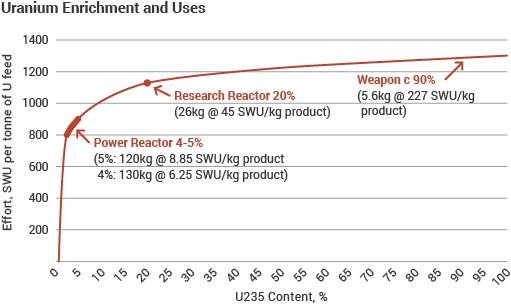
What is even more scaring is that scientists concluded that a nuclear bomb could already be made from a 10%-uranium-235 concentration onwards.[14] Even when such a bomb would be very unpractical to be made – a lot more uranium is needed to make such a bomb – it is not impossible according to these USA-scientists. This makes every uranium enrichment facility, even the actual production of LEU and HALEU, a potential direct producer for atomic bombs material.
- Plutonium at the core of atomic fission and thermonuclear fusion bombs
The same types of nuclear power stations (PWR, BWR, but also gas-cooled reactors like Magnox and AGR, as well as most SMR desings) don’t only use atomic weapon-usable uranium-235 (when produced in higher concentrations in the uranium-enrichment facilities). Another element is created during the nuclear fission in their reactor cores. Natural uranium consists of 0,7 % uranium-235, and 99,3% uranium-238. The first is partially “consumed” during the fissionprocess to unleash the heat needed for boiling water to high-pressure steam, needed for the production of electricity. But while the concentration of uranium-235 is decreasing, the concentration of plutonium-239 is rising. The neutron-bombardment that is splitting uranium-235, is also creating another element. Uranium-238 is not a fissile material. But it is a fertile element, that evolves to fissile plutonium-239 by absorbing one free neutron.
This plutonium-239 is usable for two types of atomic bombs. One type is the fissionable-plutonium-239 atomic bomb, like the USA used to bomb Nagasaki on 9 August 1945. Any country producing plutonium in its NPP’s is able, if reprocessing is applied, to separate the plutonium-239, and use it for the production of Nagasaki-like atomic fission-bombs. Such bombs are more complicated than the uranium-bombs. They rely on a perfectly shaped subcritical plutonium-sphere, that needs to be compressed by a perfectly simultaneous conventional inner explosion around it. This implodes the plutonium-sphere, making it supercritical so that it explodes.
Another type is the thermonuclear fusion bomb, also called the hydrogen fusion bomb. This bomb is far more powerful than the uranium-235 or plutonium-239 fission atomic bombs. But it is also much more complicated to make. Such a bomb is simultaneously a “fission” (nuclear reactive) and fusion bomb, with a multi-phase explosion. A plutonium-239-explosion creates in a “first phase” a fast neutron bombardement, producing fusionable deuterium en tritium from lithium deuteride (LiD) inside the bomb. The present deuterium undergoes in a “second phase” fusion with the present tritium, which is creating the enormous heat and power of this type of bomb.
- Does fusion and thorium create nuclear power with no or less proliferation risk?
This supercritical fusion process in a hydrogen fusion bomb, is related to the critical process of a fusion NPP, just like the supercritical fission atomic bombs are related to the critical processes in fission-based NPP’s. Both fusion processes are based on the fusion of two isotopes of hydrogen, being deuterium and tritium. Saying that there is no link, is denying declarations of US and UK officials, who confirm that successful testing with fusion processes is good for “national defence and the future of clean power” [15] – the same sentence they use for fission applications.
The same applies for another “hype”, the disinformation around thorium reactors. One of the arguments used by its propagandists is that thorium is not fissile, and thus can’t be used for nuclear bombs at all. When confronted with the argument that fertile thorium-232 evolves to the fissile uranium-233 (which doesn’t exist in nature) when it is bombarded with neutrons, the argument is that it is much more difficult to acquire this material. This is not fact-proof. The USA has tested a uranium-233 fission bomb on 15 April 1955, which exploded with a strength exceeding the Hiroshima-bomb power with around 50 %.[16] The US also has maintained a stockpile of around two tons of uranium-233.[17] They considered it as a highly usable fission-type atomic bomb, but preferred the further development of the already much more settled plutonium-chain. They didn’t see the necessity to develop parallel production chains of plutonium-239 and uranium-233. Also India has tested a thorium/uranium-233 bomb.
In 2012, Stephen Ashley and others pointed out[18] that thorium reactors produce pure proactinium-233, as in not polluted by other proactinium isotopes. This proactinium can be separated chemically and then decay into pure uranium-233, without pollution of uranium-232 from the thorium decay.Thorium reactors can also be used to breed plutonium by mixing uranium-238 in the fuel feed.
- Conventional weapons and weapon systems with radioactive waste
Beside nuclear or atomic explosion bombs, we see that decades long, different armies in the world have developed conventional weapons and weapon systems with radioactive material integrated into them. The USA seems to be the absolute champion in this respect. They have a great variety of ammunition strengthened with depleted or polluted uranium. One of the best known and efficient weapon systems using depleted or polluted uranium is the A-10 Warthog, also called “tank killer”. It is equipped with a fast firing canon using uranium-hardened ammunition, penetrating the armour of enemy armoured vehicles and tanks. This material results in the ammunition penetrating the armour, sharpening itself when doing so, and igniting at very high temperatures. This has as a consequence that eventual ammunition present in the enemy armoured vehicles or tanks explode, destroying them completely. When burning at very high temperatures, the uranium in the hardened ammunition doesn’t melt, but evaporates in very tiny particles, being blown away where the wind carries them, contaminating soldiers, civilians and the environment at large. This uranium is sourced from different civilian/military installations. Uranium enrichment facilities concentrate uranium-235, but concentrate at the same time the waste to even more pure uranium-238, from 99,3 up to 99,7%. Other facilities are reprocessing plants, who separate remaining uranium-235 and plutonium from spent nuclear fuel. While doing so, they create another type of waste. It is also a kind of uranium-238, but then polluted with transuranic elements, like plutonium-239 and americum-241.[19] That’s why we name this polluted uranium, rather than depleted uranium. 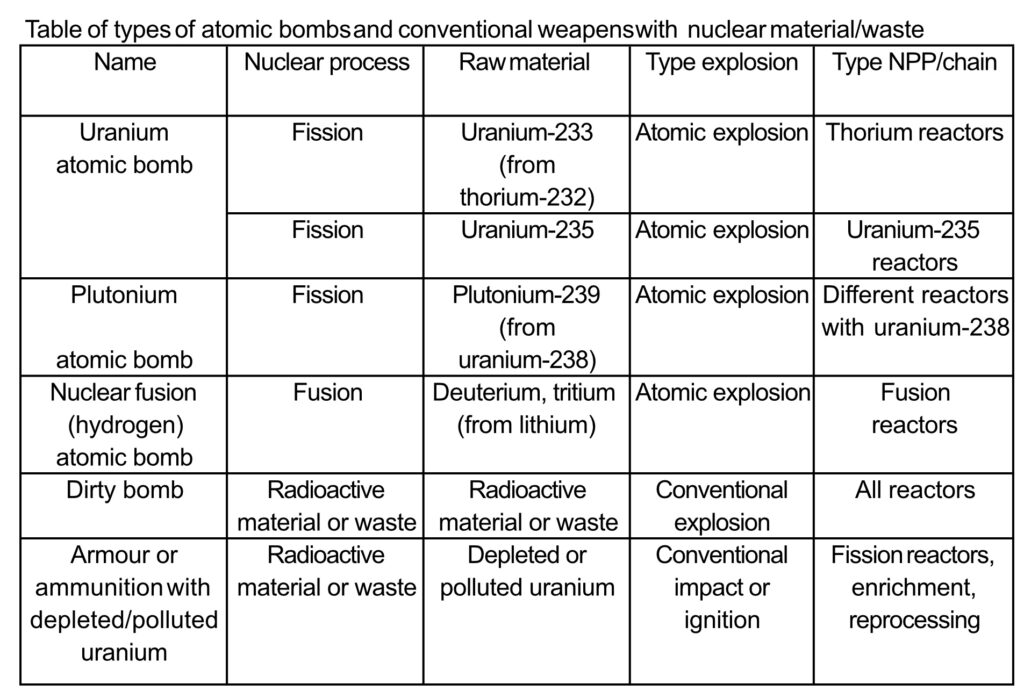
Last but not least, nuclear power contains radioactive materials in every step of its chain. When terrorist groups succeed in obtaining nuclear material or waste, by theft, on the black market or by any other means, they could be able to make a conventional dirty bomb, integrating in it radioactive material. When this bomb explodes, it creates a terror effect, because of the invisibility of radioactive contamination. The longer the civilian or military nuclear chain, the more steps (including the many transports in between nuclear facilities), where they can obtain nuclear materials and waste.
In the table below you can distinguish four different types of atomic fission or fusion bombs, completed with two conventional DU and dirty conventional ammunition and bombs – and how they are related to different types of actual and “new” types of nuclear power.
- Military grounds for the craze of SMR’s and MMR’s
The next myth that nuclear propagandists use, is that SMR’s would solve nearly all problems, including proliferation problems. But exactly the opposite is true. SMR’s worsen nearly all existing problems from traditional reactors. An important one is the characteristic that most need heavier fuels, and thus create also more hazardous waste. Both elements are source for even worse proliferation problems. Heavier fuels mean for example the broader use of HALEU. This means that the production of nuclear fuel itself is nearing weapon-usable grades of this kind of concentrated uranium, since there is, as shown above, already risk for weapon-usability with 10% concentrated uranium-235. The same applies for waste. An American study, published in PNAS, concludes that three different types of SMR’s (Nuscale-iPWR, Toshiba-SFR, Terrestrial Energy-IMSR) create 5 to 35 times more waste per KWh, compared to their plus 1 GW-“big brothers”.[20] More waste means also more potential proliferation risk, because the content of the waste changes a lot compared to actual reactors. There will also be more depleted uranium, because more uranium ore is needed to obtain higher enriched uranium-235.
Why then do some advertise SMR’s as part of the future? They are not alone, but they are numerous and very powerful: military lobbyists. They work hard to extend the use of SMR’s and MMR’s (Micro Modular Reactors, reactors up to 20 MWe) for military use. When a parallel civilian SMR-sector is developed, then science on SMR’s increases and some costs can be passed on to the civilian sector (see further). And the ambitions go far. Not only are around 200 SMR’s already active in different navies, most of all-in the US Navy. But programmes want to expand SMR’s for the propulsion of nuclear powered aircraft carriers and submarines in quantity and quality. The AUKUS program is one example of expanding nuclear fleets, even in countries that never had it before, like Australia.[21] But it is not limited to that. Military planners want new nuclear weapons and weapon-systems. One example is the Russian nuclear-powered and nuclear armed Poseidon torpedo.[22] Or the Russian nuclear powered (and armed?) Burevestnik Cruise missile with a nearly unlimited range.[23] The US dreams already for long of nuclear powered and nuclear armed strategic bombers, giving them a near unlimited range as well. Also other fixed or mobile SMR’s and MMR’s are developed for military use. It is no coincidence that from the 58 detail concepts mentioned in the NEA study, 20 are US American [24]
- Ordinary people pay a heavy toll for increased corporate profits
Some will profit heavily from these evolutions, like oil and gas companies, the nuclear branch, the military-industrial-financial-political complex. And others will suffer enormously from these evolutions. It will cost people much more when these evolutions are not stopped and reversed. First of all are the rising costs, in a context where life conditions for ordinary people are already painfully challenging. Energy prices go up directly and indirectly, when nuclear energy is expanding its expensive production. But the siamese twins civilian and military nuclear increase these costs even more. A study from the University of Sussex concludes that passed on costs from military nuclear, especially the nuclear submarine fleet, on civilian nuclear energy production, together with missed lower renewable energy prices, cost the UK-electricity consumers around 5 billion £ every year. [25]
There is even worse. Climate policies undermined and neglected by expanding nuclear will worsen living conditions most for those who have the least responsibility for climate warming. The nuclear dangers for public health because of permitted nuclear emissions, (extreme) nuclear accidents and possibly terrorist and military attacks on vulnerable nuclear installations, all threaten life conditions, health and even life itself. The last applies even more for war, especially nuclear war, a possibility that can not be excluded. Particularly not with the actual European war-mongery-policies in place of peace building and diplomacy. It is definitely not the rich and powerful that will go to war. While they incite ordinary people to go to war, they are privately building wealthy shelters with plenty supplies.[26] At the end, blood of ordinary people will be shed for private interests of the few.
- Abusing the climate degeneration and undermining climate policies
One of the most cynical things is that nuclear dares to present itself as a solution for the climate degeneration. Together with other lobbies like the fossil and agrochemical lobby, they rely on a dangerous myth concerning climate degeneration: we should reach so called “climate neutrality”. Nuclear can contribute to that, they argue. Nuclear is a so called carbon-poor energy form, and can thus help reach the illusion of climate neutrality. But this “goal” is not what IPCC is presenting as necessary policy. They motivate with ample arguments that we need a policy of net capture and utilisation or storage of greenhouse gases. In the last report AR6, IPCC indicates that in order to realise or to return to a maximum 1,5°C warming, we must capture and use around (or even more) than 300 billion tons of atmospheric and oceanic CO2 before 2100.[27] This is what neither fossil gas even with CCS, nor nuclear can do. Only a good mix of renewables and accompanying measures like energy-efficiency and -sufficiency, storage, demand side management and interconnection can realise this.
Furthermore, nuclear is highly incompatible with flexible renewables. If we need complementary energy to variable renewables, it has to be a highly flexible complementary energy as well, easily to switch off and on, without the dangers that such policies would lead to dangerous nuclear wear-off when heating-cooling-heating nuclear installations could endanger fatal flaws in the installations. In reality, nuclear tends to deliver baseload power, a concept that doesn’t fit with renewable flexibility. On top of this, nuclear is so expensive and slow to realise, that less renewables can be paid for, and that we need a much longer period to use fossil gas as so called “transition fuel”. It is not by chance that fossil gas enterprise Centrica has invested in UK-Sizewell C. When this development goes on, Centrica Gas is guaranteed to deliver much longer expensive and climate degenerating fossil gas.[28]
- We need a strong anti-nuclear peace and climate movement
It is becoming ever clearer that both civilian and military nuclear are strongly intertwined. This leads to a series of devastating consequences. Socially just renewable and climate-positive energy policies are undermined, and replaced by more expensive and slower to realise nuclear energy, especially with the passed-on costs of military nuclear. The latter increases the costs further. The danger for either a climate apocalypse or nuclear armageddon, or a combination of both increases when we do nothing and let it happen.
So we have a choice: we become fatalistic, discouraged or hopeless. Or we stand up and resist these evolutions. The numerous battles led for solidarity with Vietnam, Palestine or South Africa, or against the threat of nuclear war, have led to victories that should not be underestimated. Let’s make links between all of us and other groups in resistance.
The successful result of the campaigns against the intermediate missiles in the eighties proves that it is possible.
[1] NPT, https://treaties.unoda.org/t/npt
[2] https://www.elysee.fr/front/pdf/elysee-module-16825-fr.pdf, p. 4
[3] https://jonathonporritt.com/uk-nuclear-policy-risks/
[4] https://www.iaea.org/publications/15943/nuclear-power-reactors-in-the-world, pdf, p. 19 https://nl.wikipedia.org/wiki/Kerncentrale_Obninsk
[5] https://www.iaea.org/publications/15943/nuclear-power-reactors-in-the-world, pdf, p. 19
[6] https://www.modernpowersystems.com/news/rip-calder-hall/
[7] https://www.theguardian.com/uk/2003/mar/21/nuclear.world
[8] Alexander Glaser, Military Fissile Material Production and Stocks in France, Department of Mechanical and Aerospace Engineering, Princeton University Engineering Quadrangle, Olden Street, Princeton, NJ 08544, pdf, p.4
[9] https://pris.iaea.org/pris/worldstatistics/operationalreactorsbytype.aspx
[10] https://en.wikipedia.org/wiki/Pressurized_water_reactor
[11] via NUCLEAR MONITOR, August 31, 2020 | Issue #889; https://world-nuclear.org/information-library/nuclear-fuel-cycle/conversion-enrichment-and-fabrication/uranium-enrichment
[12] NEA, Nuclear Energy Agency (OECD), 2024, The NEA Small Modular Reactor Dashboard: Second Edition, NEA No. 7671
[13] Urananreicherungsanlage Gronau und Zentrifugenforschung Jülich Gefährdung für Atomausstieg und Frieden, SOFA, Münster, März 2022, p. 27
[14] Untitled declassified document (“Commissioner Action”), 14 February 1978, pdf, p. 7/8; Brown, A., Glaser, A., On the Origins and Significance of the Limit Demarcating Low-Enriched Uranium from Highly Enriched Uranium, pdf, p. 4
[15] https://www.power-technology.com/news/scientists-achieve-second-nuclear-fusion-breakthrough/?cf-view&cf-closed
[16] https://nuclearweaponarchive.org/Usa/Tests/Teapot.html
[17] https://thebulletin.org/2014/05/thorium-the-wonder-fuel-that-wasnt/#post-heading
[18] https://www.nature.com/articles/492031a – See also: https://thebulletin.org/2018/08/thorium-power-has-a-protactinium-problem/
[19] https://www.who.int/publications/i/item/WHO-SDE-PHE-01.1, hfst 1-3
[20] https://www.pnas.org/doi/pdf/10.1073/pnas.2111833119
[21] https://www.mo.be/analyse/wereldmachten-spelen-zeeslag-indische-en-stille-oceaan?utm_campaign=emo&utm_medium=newsletter&utm_source=email
[22] https://nautique.nl/artikel/668537/rusland-presenteert-geheime-onderzeeer-die-een-tsunami-kan-veroorzaken
[23] https://businessam.be/rusland-test-nucleaire-kruisraket-burevestnik/
[24] NEA, Nuclear Energy Agency (OECD), 2024, The NEA Small Modular Reactor Dashboard: Second Edition, NEA No. 7671
[25] https://www.worldnuclearreport.org/IMG/pdf/wnisr2024-v2.pdf, p. 333-336
[26] https://www.bbc.com/news/articles/cly17834524o
[27] https://www.ipcc.ch/report/ar6/wg1/figures/summary-for-policymakers/figure-spm-4; IPCC_AR6_WGI_SPM.pdf, p.13
[28] https://www.theguardian.com/environment/2025/nov/28/after-a-career-as-an-environment-writer-heres-what-i-have-learned; https://www.centrica.com/media-centre/news/2025/completion-of-investment-in-sizewell-c/