

Nuclear Monitor #939
Lynda Williams
Nuclear Free Hawaiʻi (Substack)
The House version of the 2027 NDAA requires deployment of untested nuclear microreactors in Hawai’i and Guam.
After nearly a century of nuclear testing in the Pacific, military bombing of Hawaiian lands, and the poisoning of drinking water at Red Hill, Hawaiʻi is again being lined up as a proving ground for an untested nuclear military program.
A provision in the House version of the $1.15 trillion FY2027 National Defense Authorization Act (NDAA) orders the Pentagon to deploy a transportable nuclear reactor in the Indo-Pacific by January 1, 2030, with priority for the Western Pacific — meaning Hawaiʻi and Guam. The amendment, sponsored by Rep. Pat Harrigan of North Carolina, passed the House Armed Services Committee on a 47-9 vote. During the markup, Hawaiʻi Rep. Jill Tokuda was the only member to speak against it. “We should not rush to deploy transportable nuclear micro-reactors anywhere until we know more about their safety, reliability, and impact,” she said.
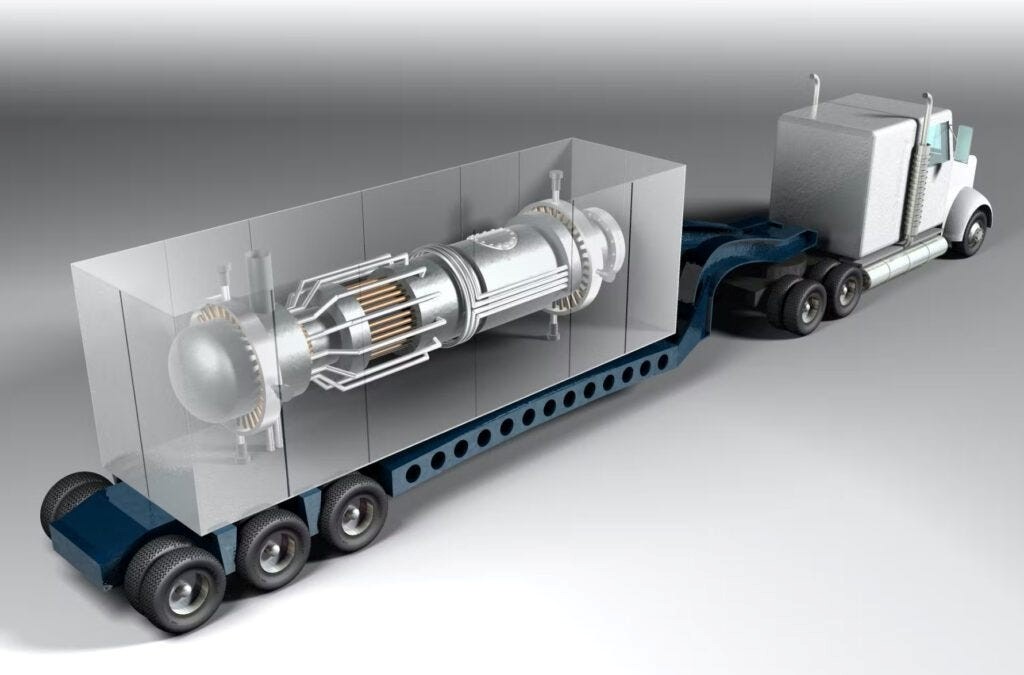
Artist rendition Power Magazine
What is a transportable nuclear microreactor?
Nuclear reactors are categorized by how much power they generate, measured in megawatts (MW), or millions of watts. A hair dryer draws about 1,500 watts. A typical commercial nuclear power plant generates around 1,000 MW. A microreactor is far smaller, generating 1–2 MW, transported in parts and assembled on site. The Department of Defense’s prototype, Project Pele, produces about 1.5 MW and will not even be tested until 2027.
But the amendment defines a “microreactor” as any reactor up to 50 MW — up to thirty times larger than Pele, and squarely what the industry calls a small modular reactor, or SMR. Guam’s old Piti power plant was about 35 MW. No matter the size or name, all nuclear reactors fission uranium and produce high-level radioactive waste — waste there is still nowhere to put, and no way to recycle away.
None of these reactors is proven. Pele is still under construction in Virginia. The designs racing to meet this deadline are venture-backed startups — companies like Oklo, Antares, and Valar — none of which has ever operated a commercial reactor, and several of which speak openly of deploying hundreds or thousands of these units. Edwin Lyman, a physicist at the Union of Concerned Scientists, calls the recent milestones rudimentary steps with no bearing on whether the technology is safe. The amendment itself requires a plan to “test and evaluate” the deployed reactor. Deployment is the test.
Where it would go, and what it would do
The amendment requires the reactor to be demonstrated during a major military exercise. The largest in the Pacific is RIMPAC — the Rim of the Pacific exercise, held in Hawaiʻi every two years, including this summer. A live demonstration would most likely be deployed on existing military land: Pohakuloa Training Area on Hawaiʻi Island or the Pacific Missile Range Facility at Barking Sands on Kauaʻi. There it would power command posts, communications, and the radar and sensor systems that forward operations and missile defense depend on.
Proponents talk about microreactors as if they are appliances that can be shipped, plugged in, used, and shipped away. The truth is drastically different.
What the Pentagon’s own documents describe
The Pentagon’s environmental impact statement for Pele describes the process. The reactor arrives in four shipping containers and is assembled on a concrete pad nearly an acre in area, loaded with 400 kilograms — about 880 pounds — of nuclear fuel. Crews build a shielding structure 30 feet tall, with two-foot-thick concrete roof panels, wrapping the reactor in a jacket of 15,000 gallons of water and two-foot dirt walls to absorb the neutrons.
The reactor runs for about two and a half years. Before it can be removed, it undergoes a “blowdown” that vents radioactive noble gas through filters into the surrounding air. Most of the support structure — more than 300 cubic meters of it — becomes radioactive waste, hauled off by the truckload. To where? The fuel itself becomes high-level radioactive waste. And the reactor does not go home. The EIS says it goes into temporary storage, awaiting “eventual disposition,” held until a national spent-fuel repository exists to take it. There is none.
That environmental impact statement covers only the prototype’s test in Idaho. There is no environmental review for deploying a reactor in Hawaiʻi, and the amendment does not require one.
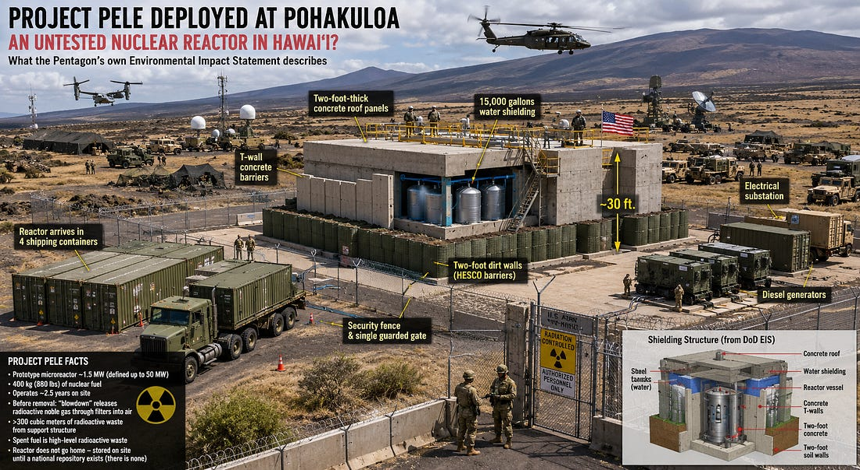
Illustration generated with AI, based on DOD specifications.
Hawaiʻi’s nuclear safeguards do not reach the military
Hawaiʻi has said no to nuclear power, repeatedly and in law. The state constitution requires a two-thirds vote of the Legislature to build a nuclear plant. Hawaiʻi Island is a nuclear-free zone. The state energy office’s Advanced Nuclear working group, on which I served, studied these very reactors and found nuclear power not viable here.
But these are state and county laws, and the military answers to federal law on federal land. A reactor placed on a base in Hawaiʻi would sit outside every protection the people of Hawaiʻi have fought for.
Guam at least secured a warning. Its delegate wrote a provision into the FY2026 NDAA requiring the Pentagon to give notice before siting a nuclear reactor there. But notice is not consent — and it covers only “permanent” reactors, so a “transportable” one may slip straight through. Hawaiʻi has nothing at all.
There is also a collision of timelines. The Army’s lease for some 23,000 acres of state land at Pohakuloa comes up for renewal in 2029 — the same window in which the Pentagon would be racing to meet this 2030 deadline. The lease is the one point of real leverage Hawaiʻi holds.
This is not a partisan problem
It would be a mistake to read this as one party’s doing. Democrats helped build the deregulatory machinery now driving the nuclear rush, from the ADVANCE Act to the campaign to fast-track reactors led in the Senate by Sens. Whitehouse and Booker. Even Gov. Josh Green co-signed a pro-nuclear op-ed with Utah’s governor, tying it to surging AI data-center demand — while his own state had already studied advanced nuclear and rejected it.
What happens next
The Senate Armed Services Committee advanced its own FY2027 version 18-9, with no provision like the Harrigan amendment. Each chamber now takes its bill to the floor, where members can offer amendments to strike provisions. Tokuda’s staff confirmed she is working with other legislators to remove the Harrigan amendment. The two chambers then meet in conference to negotiate a single final defense bill. The Harrigan amendment is in the House version. The Senate’s is not. If it survives the House floor, conference is the last chance to strip it.
Before it reaches that table, Hawaiʻi’s entire congressional delegation — Rep. Tokuda, Rep. Ed Case, Sen. Hirono, and Sen. Schatz — must release a joint statement opposing the deployment of untested, unproven nuclear reactors in the Pacific, and commit to keeping the Harrigan amendment out of the final bill.
In 2024, the Hawaiʻi County Council repealed the military exemption to its 1981 nuclear-free law — applying the ban to the armed forces as well. Now the whole state must do the same — the Pentagon included.
First published at https://substack.com/@nuclearfreehawaii