

Nuclear Monitor #937
Jan van Evert
In the evening of March 25th the first transport of high radioactive nuclear waste was carried out from an old research reactor in the German city Jülich, about 40 kilometres west from Cologne, to Ahaus, roughly 180 kilometres to the north. Both cities are located close to the Dutch border. The material is transported in so-called Castor containers. A total of 152 containers have to moved to the new location.
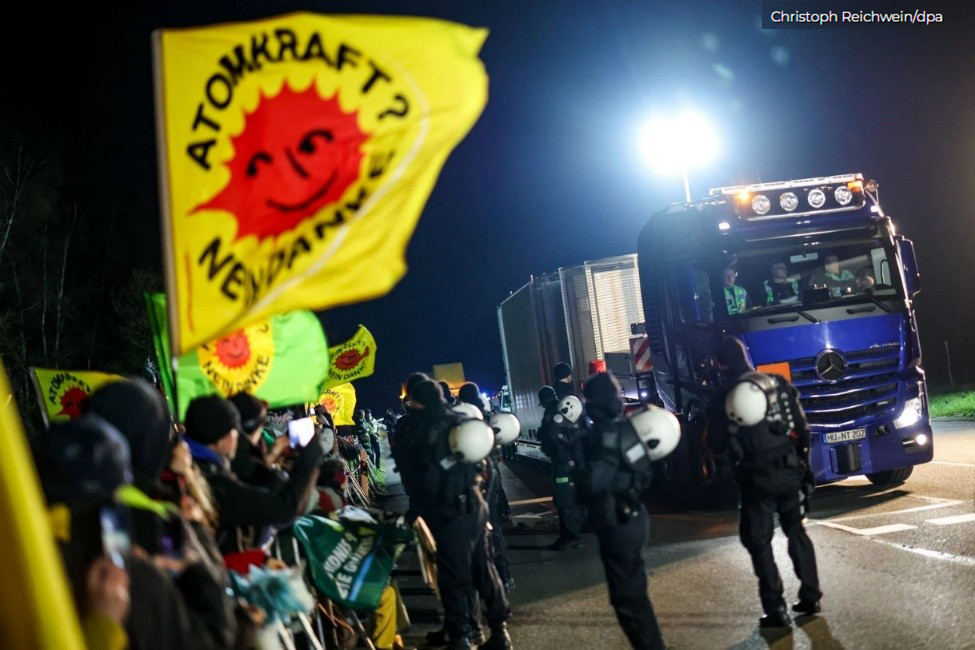
The convoy comprises a hundred vehicles and was accompanied by a massive police force: a total of 2400 police officers were employed to protect the transport. It is the largest transport of nuclear waste in Germany in decades. The licence for the transports was granted in the summer of 2025 and is valid for two years. Various anti-nuclear groups have been demonstrating against the shipments, both in Jülich and in Ahaus. There were repeated minor attempts to block the road but they were unsuccessful. The waste had to be moved because the license to store it in Jülich already expired in 2013. The costs for the transport added up to 90 million Euros. This does not include the cost of the police that were needed. A spokesman of the police union had already described the transports in advance as a “pointless mammoth task”.
A plan to build a new storage in Jülich was cancelled because the costs appeared to be too high. Anti-nuclear activists in Germany criticized the transport arguing that the construction plans for a new storage in Jülich have not been investigated properly. They are not alone: even the government of the state of Nordrhein-Westfalen is against the transports. The state government has even reserved a plot and a budget to build such a storage. But they were overruled by the federal government that has the authority in this case.
The federal government states that it has not terminated the plan for a new storage in Jülich but their opinion is that it takes to long to build. Moving the nuclear waste is a quicker solution.
The biggest problem remains unsolved: the storage in Ahaus is one of sixteen temporarily storage facilities in Germany. The licence already expires in 2034; Germany is still searching for a location for the permanent storage of nuclear waste. A process that is expected to last at least another fifty years at best according to the German Öko-Institut. (See Nuclear Monitor 918).