

Nuclear Monitor #941
Article by A Quiet Resistance and Radiation Free Lakeland
Ticking Boxes
“For extra tea and flashy things, that overtime some boxes bring with
Elements whose mass can change the genes of everything in range.
Trapped outside their ticking box where spillage flows like molten rocks
With dangers left to grow unseen until one idle Chargehand’s scream said
“Shut it down and do it quick before we’re all in deepest shit there’s been
Another situation, critical to every nation.”
Extract from poem, Ticking Boxes, by Duncan Ball, one of the founders of Radiation Free Lakeland
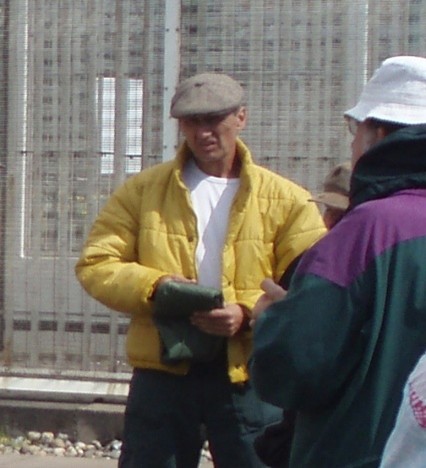
Image: Duncan Ball outside Sellafield
Resistance seems futile?
To read of the measured consequences of disasters like Chernobyl and Fukushima, you would be forgiven for believing that all the fuss about nuclear contamination is over nothing. The final death count from Chernobyl has been highly contested ever since Valery Legasov predicted 40,000; meanwhile, more people were said to be affected by forced evacuations during Fukushima than by radiation-related illnesses.
You’d think the fires would be left to burn if radioactive release is of so little consequence.
Yet the nuclear industry publicly plays up its attention to safety, with all the procedures and protocols in place so they can say disaster is an ‘unlikely event’.
Then again, whistleblowers—scientists and engineers—complaining of inconsistent and dangerous practices at Sellafield have been vilified and forced out of their jobs.
Some, like Duncan Ball, one of the early founders of Radiation Free Lakeland, died of radiation-related illness at a young age, a consequence that tells more than paperwork, ticked boxes, and claims of safety.
A former Sellafield foreman, Duncan’s experience followed the same route as dissident scientists, “Rodney Fordham, John Taylor, Ross Hesketh and Trevor Brown[,] … scientists who worked in the British nuclear power program. Each of them expressed doubts about some aspect of nuclear safety, initially through normal internal procedural channels. When they made their criticisms public, or threatened to do so, the nuclear industry attacked them in various ways, such as by criticism of their work, transferral or dismissal”. Ref: Rob Edwards, “A new kind of nuclear victim”, New Statesman, 22 July 1983, pp. 8-10.)
The nuclear industry is riddled with contradictions over safety, blessed with laissez-faire attention from regulators and slavering enthusiasm from local councillors, and greenlighted by credulous MPs.
Organisations like Radiation Free Lakeland exist because without them, proper scrutiny would be avoided. Power must be held to account, but it’s a slow, complicated road, like most travel in Sellafield’s home of West Cumbria.
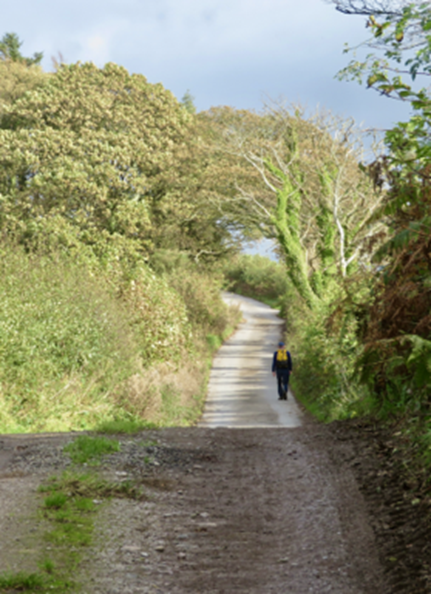
Image: A road near Sellafield
Sellafield became
(AQR) My dad was a 9-year-old kid in Workington on October 10th, 1957, the date the Windscale Fire put West Cumbria on the nuclear disaster map. Marked 5 out of 7 on the International Nuclear and Radiological Event Scale (INES), Windscale’s disaster was an ‘accident with wider consequences’.
Consequences an order of magnitude beyond local.
Winds took radiation east across the UK and further afield to Eastern Europe, despite contemporary claims that it blew out across the sea to the north.
Within a 10–20 km radius of Windscale, the UK government under Harold Macmillan imposed a milk ban for a month, due to the known carcinogenic effects of Iodine-131 passing through milk to the human thyroid gland. Less was said about polonium, tritium, and other elements released at the same time, and documents were classified until the 1980s to ensure the details didn’t get out.
Although various studies have claimed there were up to 100–200 cancer-related deaths associated with the event, the delay between the disaster and later developing cancers and radiation-linked diseases has made certainty impossible. My dad and his siblings didn’t seem to have been affected by the event, but I’ve long been suspicious of the health problems in later generations of his sister’s family. Little is ever said about the ways in which women and children are specifically harmed by radioactive releases, differently from men. (AQR)
Despite the site’s later civil use in the production of electricity alongside plutonium for bombs at Calder Hall, Windscale Pile 1 was purely a plutonium factory, a military site, for the purposes of constructing atomic bombs.
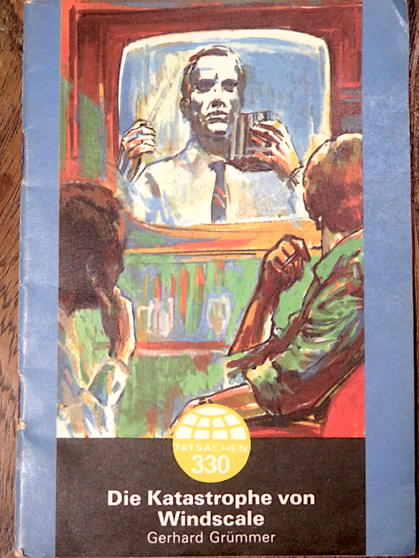
German biologist and science writer, Gerhard Grümmer, wrote in his booklet, Die Katastrophe von Windscale, that at the time of the fire, ‘Calder Hall I, and the Calder Hall II plant, which was under construction, were shown on the map. Next to them were the Windscale I and II plutonium factories, as well as a building where plutonium was extracted. “Bomb-clean plutonium,” the newspapers assured, “usable for military purposes!”’ (Google translated).
Over the decades, the site’s functions expanded. From 1964, it began reprocessing spent MAGNOX fuel, separating plutonium from uranium for use in weapons.
In 1981, the name was changed to Sellafield. Now larger than surrounding villages and towns, with a contaminated concrete and steel mass visible from Lakeland’s Coniston Old Man on a clear day, its presence dominates West Cumbria.
Windscale Pile I, the site of the 1957 fire, is still being decommissioned, 69 years after the fire, testament to how dangerous and complicated radioactive material can be.
Despite the fudging of numbers, the denials of deaths, and the refusal to get behind public responsibility, the inherent danger of radioactive materials is real, and must not be dismissed as ‘radiophobia’ or anxiety.
Early days, and why the fight is so tough on a local level
Radiation Free Lakeland was formed following a Cumbria County Council meeting in November 2008 in which furious County Councillors were not allowed to vote on whether or not to ‘express an interest’ in a nuclear dump. The decision was to be left to a few councillors on the Cabinet.
At that heated Cumbria County Council meeting, Radiation Free Lakeland took along a small placard which is still the group’s logo today.
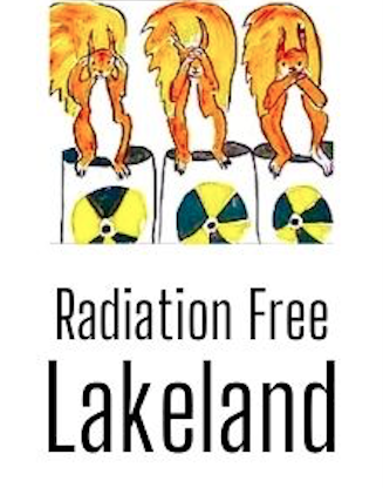
Three red squirrels seated on barrels of nuclear waste “Hear no Evil, See No Evil, Speak No Evil,” a reference to the Nuclear Decommissioning Authority’s (NDA) tax-payer-funded nuclear slush fund, which—then, and now—has saturated almost every facet of Cumbrian life. Charities, local businesses and wildlife groups have all taken the nuclear bung.
Maybe this language sounds inflammatory to you. We’re so used to reading unimpassioned phrasing of terrible events in the News. But Sellafield Ltd. funded by the UK Government’s Nuclear Decommissioning Authority owns almost the whole of West Cumbria, one way or another. Play parks are funded by the ‘company’ and commissioned by local councils. Town councils partially fund their ‘town deals’ with public money filtered through the NDA. Charities take it, too, because ‘free’ money is hard to come by in today’s economic climate.
Local people are frequently ambivalent to the dangers presented by the nuclear facility partly because in a widely impoverished area with lousy infrastructure—terrible roads, broken railway service, and inconsistent buses, hospitals frequently over an hour’s drive away, few NHS dentists, limited secondary school options, limited work—they’ll take the benefits provided by a flow of money at a community level, rather than struggle to live in the place they love. Add to that the constant nudging on social media about the ‘benefits’ provided to the area by the nuclear industry, and the apparent withdrawal from the nuclear fight by environmental NGOs—it’s not surprising that people have gradually found it harder to figure out who is working with their best interests in mind.
The bung is now dressed up with the socially acceptable title of ‘Social Impact Funding’, with additional funding available for areas willing to accept the ‘search’ for a suitable location for the newest nuclear dump proposals. But no number of play parks, reinvigorated buildings and clever arguments will save West Cumbrians in the face of a nuclear disaster. Or from the slow trickle of tritium, technetium, or plutonium into the ground water.
We stopped the nuclear dump before. We can do it again.
Despite the nuclear largesse, RaFL’s lobbying and campaigning, underpinned by advice from scientists and geologists, led to other groups becoming active to fight the plan.
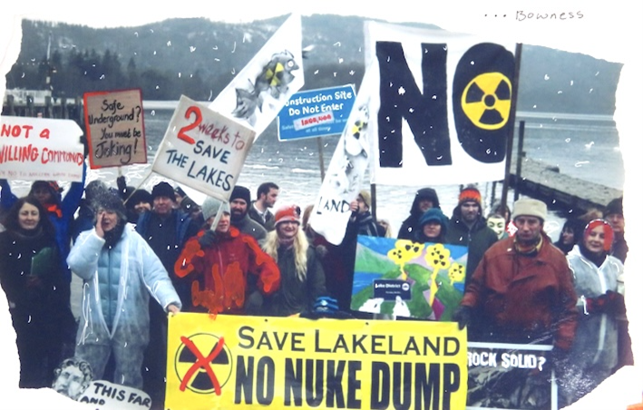
Image: Radiation Free Lakeland Demonstration at Bowness in 2013
Together, we lobbied for Cumbria County Council to hold a full debate and full vote by all councillors, and that informed the Cabinet’s decision in 2013 not to proceed with the nuclear dump plan for onshore burial of nuclear wastes.
But now the plan is back. It is worse than ever, with an intention to bury 140 tonnes of plutonium (not to mention over 27 nuclear submarine hulls) under the seabed off the Cumbrian coastline.
Even if the science for geological disposal was solid, which it isn’t, the leaks and releases from Sellafield over the years do not lend the kind of trust needed for an undertaking of this magnitude.
The nuclear dump timeline shows just how the nuclear dump net is tightening around Cumbria.
NUCLEAR DUMP TIMELINE
1997
Cumbria County Council’s rejection of exploratory boreholes (a Rock Characterisation Facility) triggers a public inquiry. The Inspector says, “the location should be in a region of low hydraulic gradients, so that there should be slow-moving and long groundwater pathways; the geology and hydrogeology of the site and its district should be readily characterisable and predictable.”
~ Chris McDonald, NIREX Inquiry Inspector. Letter from Chris McDonald to the Guardian 2007 https://www.theguardian.com/world/2007/jun/28/nuclear.uk
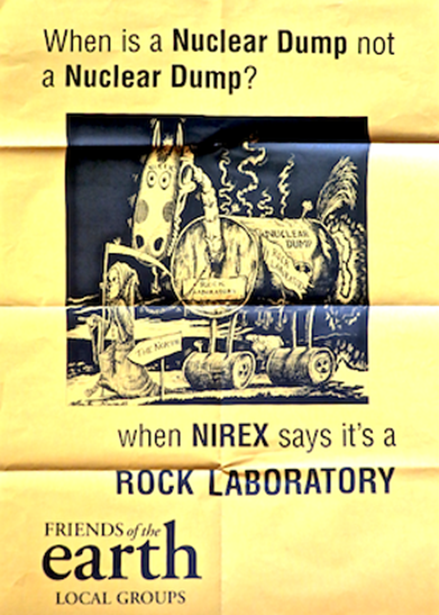
Image: Friends of the Earth 1990s poster opposing nuclear dump
2008
“Geological disposal safety plans do not assume that total containment by engineered barrier systems forever is possible.”
~Dr Adrian Bath, Engineered Barrier Systems: What are they for and how do they relate to the geosphere? A Presentation. https://www.geolsoc.org.uk/~/media/shared/documents/policy/Policy%20Meetings/Bath.pdf?la=en
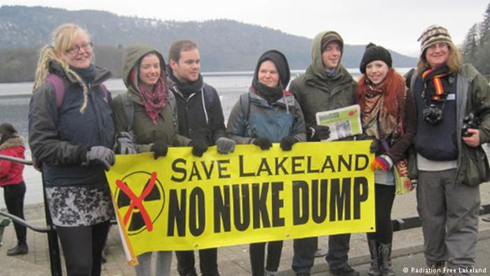
Volunteer group, Radiation Free Lakeland, formed in 2008 to fight the Geological Disposal Facility plans.
2010
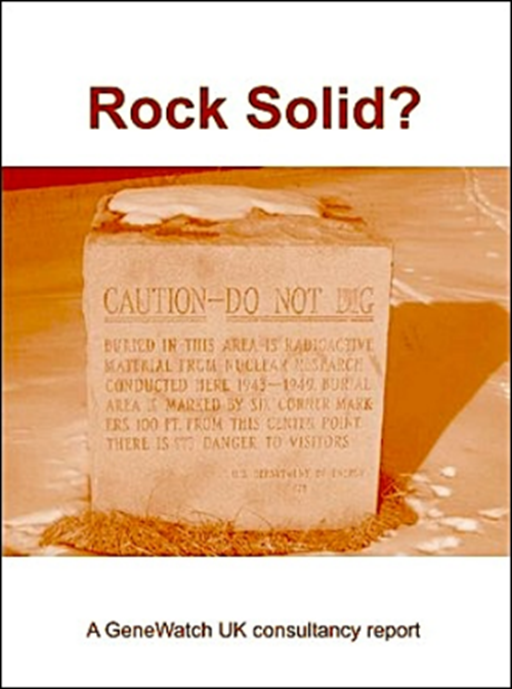
“Build-up of gas pressure in the repository, as a result of the corrosion of metals and/or the degradation of organic material, could damage the barriers and force fast routes for radionuclide escape through crystalline rock fractures or clay rock pores.”
~Dr Helen Wallace, Rock Solid? A scientific review Sept 15th 2010 https://temelin.cz/ke-stazeni/odborne-studie/rock-solid-helen-wallace-genewatch-uk-eng
2011
”I would like us to set a goal of putting the first waste into a geological disposal facility by the end of 2029. I have tasked the Nuclear Decommissioning Authority to look at opportunities for accelerating progress to meet this aim.”
~Charles Hendry MP, Chair of the Geological Disposal Implementation Board, Department of Energy and Climate Change Press Release 28th June 2011.
2012
“This groundwater will return to the surface [or the sea bed] much faster, within a few decades, if hot temperature, high-level waste is also buried. That heat will also make the land surface rise. No earthquakes or extra rainfall are needed.”
~Professor Stuart Haszeldine OBE FRSE C.Geol, Cockermouth Public Meeting Feb 2nd 2012
2013
“When I came away from the International Conference in Canada, after speaking to many experts from all over the world, I was quite convinced that there was no alternative to a GDF. Then I started my research in earnest … the more I read and studied and listened, the less certain I became that a GDF in Cumbria was the solution to Cumbria’s or the UK’s nuclear waste.” Council Leader Eddie Martin’s speech to Cumbria County Council’s Cabinet 30th January 2013 when CCC voted not to proceed with GDF “steps”. https://mariannewildart.wordpress.com/2013/02/06/eddie-martins-speech-to-cabinet-on-30th-january/
2015
Government makes Geological Disposal of Nuclear Waste a Nationally Significant Infrastructure Project with exemption from regulatory planning process. A yet-to-be-decided “test of public support” would be limited to the immediate area of the GDF. https://theecologist.org/2015/apr/02/dump-nuclear-waste-first-they-must-dump-democracy
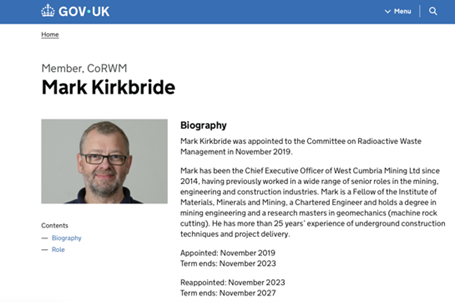
Image: Screenshot from UK Government website, appointment of coal mine developer to nuclear dump committee “Committee on Radioactive Waste Management.”
2019
CEO of West Cumbria Mining (coal mine developer) is appointed to the Government Committee on Radioactive Waste Management (now Nuclear Waste Services).
Mark Kirkbride’s brief is ”provision of advice (to Government) on activities relating to the continued development of a Geological Disposal Facility safety case,” and “GDF siting activities, including selection criteria, methods of investigation, and the timescale for carrying out site selection in the three rock types,” and to “advise on new technologies that could be applicable to the development of a GDF including those in the mining and construction sectors and their potential impacts on a GDF programme.”
~https://www.change.org/p/sack-cumbrian-coal-mine-boss-from-government-advisor-role-for-nuclear-dump
2022
“Cumbria County Council will cease to exist in May 2023. The government chose the new Unitary boundary to coincide with pro-nuclear councils.” ~Dr Kate Willshaw, Friends of the Lake District https://allerdalecopeland.greenparty.org.uk/2022/01/30/disposal-of-nuclear-waste-in-cumbria/
Geological Disposal Facility “Partnerships” formed, following a vote by a handful of Copeland Councillors: “As part of the search for a suitable site to build a Geological Disposal Facility, the Mid Copeland GDF Community Partnership has formed and … has given access to £1million Community Investment Funding per year.”
~Mid Copeland GDF Community Partnership https://midcopeland.workinginpartnership.org.uk/three-community-projects-awarded-grant-funding-from-gdf-programme/
“Formation of the South Copeland GDF Community Partnership has given access to £1million Community Investment Funding per year from the GDF programme. The project to benefit from this first round of funding was Millom Cricket Club, receiving £31,236 to make improvements to the clubhouse and facilities.”
~South Copeland GDF Community Partnership May 10th 2022 https://southcopeland.workinginpartnership.org.uk/first-projects-in-south-copeland-receive-grant-funding-from-gdf-programme/
“The UK government’s Nuclear Waste Services (NWS) is set to carry out seismic surveys off the Cumbrian Coast between July and August this year. They are looking for a place to dispose of the waste produced by Britain’s nuclear reactors.”
~Charlie Jaay in Euronews.green https://www.euronews.com/green/2022/06/22/the-uk-is-searching-the-sea-for-a-nuclear-dump-site-and-the-risks-to-marine-life-are-huge June 2022
Where does our resistance go from here?
The rest of the story is up to all of us.
How clear can we make it to the public that nuclear power is dangerous? How many experts can we provide to prove that nuclear waste stored under the seabed in a highly pressurised hydrogeological environment is a catastrophe waiting to happen?
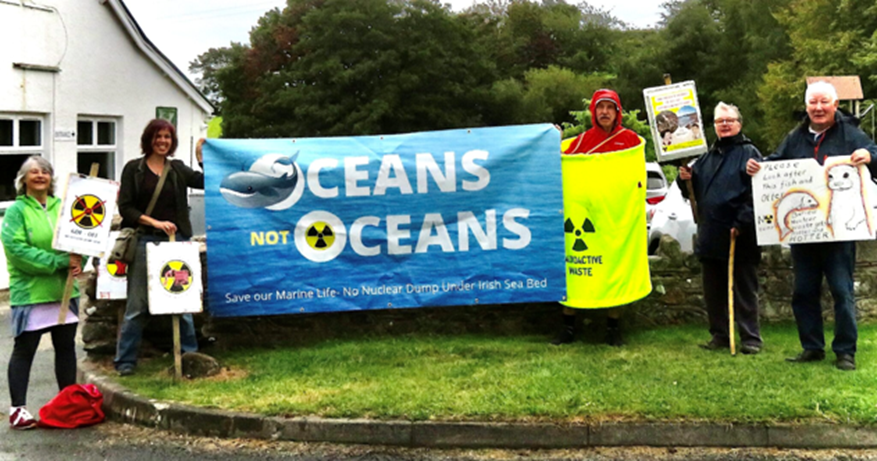
Image: Demonstration outside Nuclear Dump “Partnership” meeting, 2025
In marketing psychology, it isn’t facts that change people’s minds. It’s the connection to their emotions and their basic needs, and right there, with basic needs, Sellafield and the NDA have West Cumbrians in a choke hold.
The current plans have all the markers of a stitch up. The bypassing of democracy in local councils—indeed, in the make up of the new councils, so cleverly arranged around nuclear acceptance—plus the tsunami of nuclear bribes to smooth the public face of a toxic industry, and all of this accompanied by ever-more nuclear waste arriving in Cumbria. Softened up, opposition ignored, dismissed and discredited, and money to furnish the community’s obvious needs—it is a credit to anti-nuclear campaigners that there is any appetite at all at a local level to fight the poison.
But there are some amazing experts out there, prepared to talk to anyone about the dangerous nature of—and the problems with—the plans. There are also some local councillors who care a great deal about both the land they live in and the people around them. We’ve got the will, even if local government are falling on their knees at the promise of nuclear monies.
The narrow ‘test of public support’ to decide if the nuclear dump plans will continue doesn’t include our neighbours in Ireland, Scotland, and the Isle of Man. It excludes anyone not being bribed. We hope that objections will come in from nearby governments to support our reasoned refusal to accept the latest plans for a very deep and extremely hot sub-sea nuclear dump. ……TO BE CONTINUED…….
Note: Radiation Free Lakeland have successfully campaigned on a wide range of issues – they were the first to oppose the now rejected coal mine in Cumbria in 2017 which would have induced seismicity just a few miles from Sellafield, they also successfully campaigned against low level nuclear waste being dumped in a coal mine at Keekle Head, Cumbria.
People can support Radiation Free Lakeland’s campaign Lakes Against Nuclear Dump by purchasing a beautiful calendar full of gorgeous photos of the Lake District where the “biggest development ever in the UK” namely a giant, hot sub-sea nuclear dump is planned. https://lakesagainstnucleardump.com/2027-calendar-for-land/