

Nuclear Monitor #933
Jan van Evert
Greenpeace Switzerland has published a report by GeneWatch UK consultancy concerning the problem of radioactive waste. The literature review identifies a number of scenarios in which a significant release of radioactivity could occur from a deep geological disposal facility.
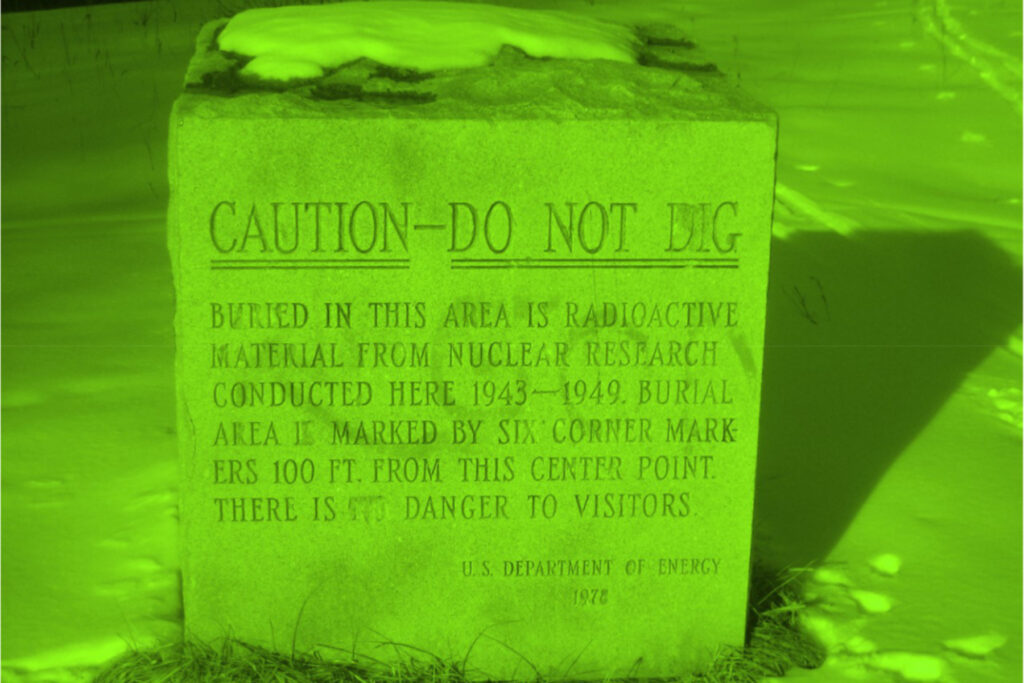
High radioactive waste will have to be stored for at least a hundred thousand years. The design life of a deep geological repository is even intended to be up to a million years. The report investigates two repository concepts: in clay rocks and in hard (crystalline) rocks. In clay rocks, the design-life of steel canisters is too short to outlast the long period of time during which the intense heat from the radioactive wastes would affect the physical and chemical processes occurring in the repository. In hard rocks, disputes regarding the corrosion rate of copper have not been resolved, bentonite can also be damaged, and groundwater and gas flow through complex networks of fractures is still not fully understood.
Future glaciation could cause faulting of the rock, rupture of containers and penetration of surface waters to the repository, leading to failure of the barriers and faster dissolution of the waste. Claims that repositories in Sweden and Finland in hard rocks would withstand expected future earthquakes and glaciations are highly speculative. Moreover, a new study by an international team of researchers has uncovered that the next ice age should naturally begin in about 10,000 years.
Several processes could cause serious problems when storing radioactive waste in both clay rocks and hard rocks. The first is the significant disturbance to the rock caused by the excavation of the tunnels and the extreme heat and radioactivity emitted by the wastes. The second is that copper or steel canisters could corrode more quickly than expected. Another problem is that the effects of intense heat generated by radioactive decay could impair the ability of backfill materials to protect the canisters from stresses in the rock and to trap radioactive substances. The heat is also sufficient to create an uplift of the rock at ground level of around ten centimetres or more, around one thousand to two thousand years after the radioactive wastes are buried around 500 meters beneath the surface. Even more serious is the increase of gas pressure in the repository caused by the corrosion of metals or the degradation of organic material. This could damage the barriers and force fast routes for the escape of radionuclides through crystalline rock fractures or clay rock pores.
The full report can be downloaded here:
https://www.greenpeace.ch/static/planet4-switzerland-stateless/2025/11/ed8ea7f1-rock-solid-2_bericht-mit-summary_de.pdf
Other sources:
https://scitechdaily.com/ice-ages-follow-a-hidden-pattern-and-scientists-just-cracked-it/